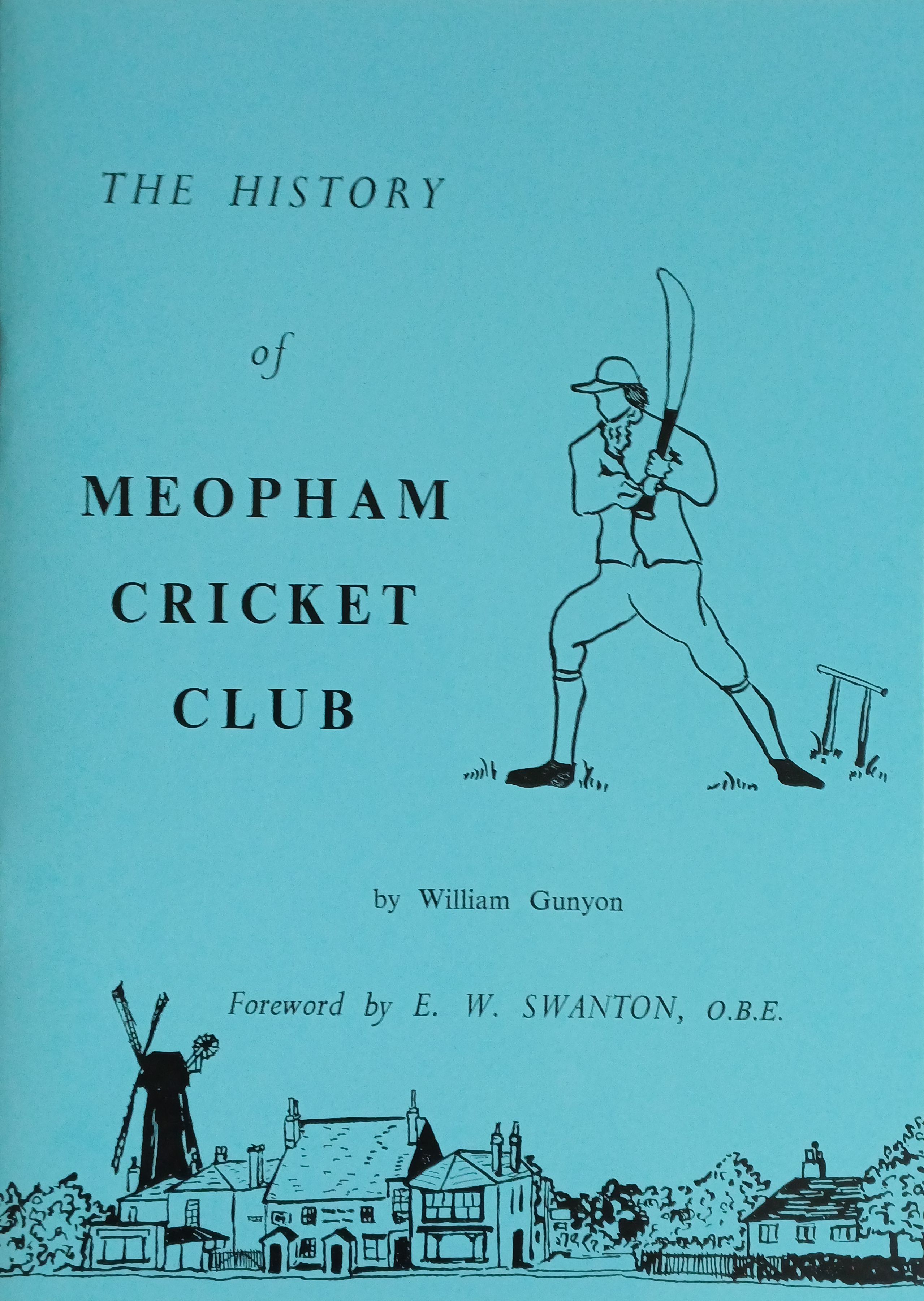
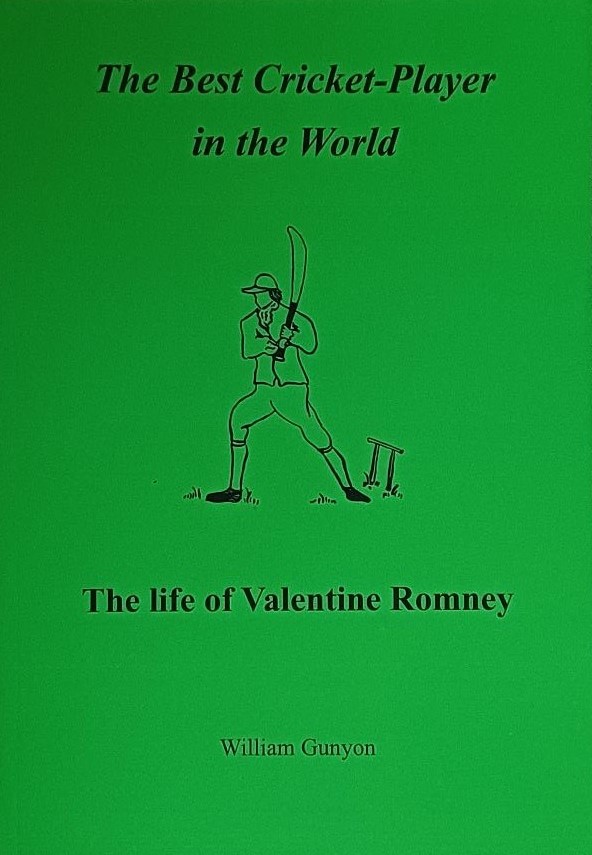
In publishing The Life of Valentine Romney last week, I can now boast of two serious attempts at researching a tiny corner of cricket history and writing it up. On subject-matter, I could describe the second booklet as a sequel. Unfortunately, any hopes of an expectant readership thirsting for more have long since dissipated. The first volume was published exactly fifty years ago.*
The interlude is easily explained by the round numbers of the calendar. Meopham Cricket Club celebrated its bicentenary in 1976 and is now busy with the 250th anniversary. The earlier effort is a history of the Club, the second focuses on its most famous individual, moving beyond his village in Kent into the world of early 18th-century cricket, then bounded by Kent, Surrey, Sussex and London.
 |  |
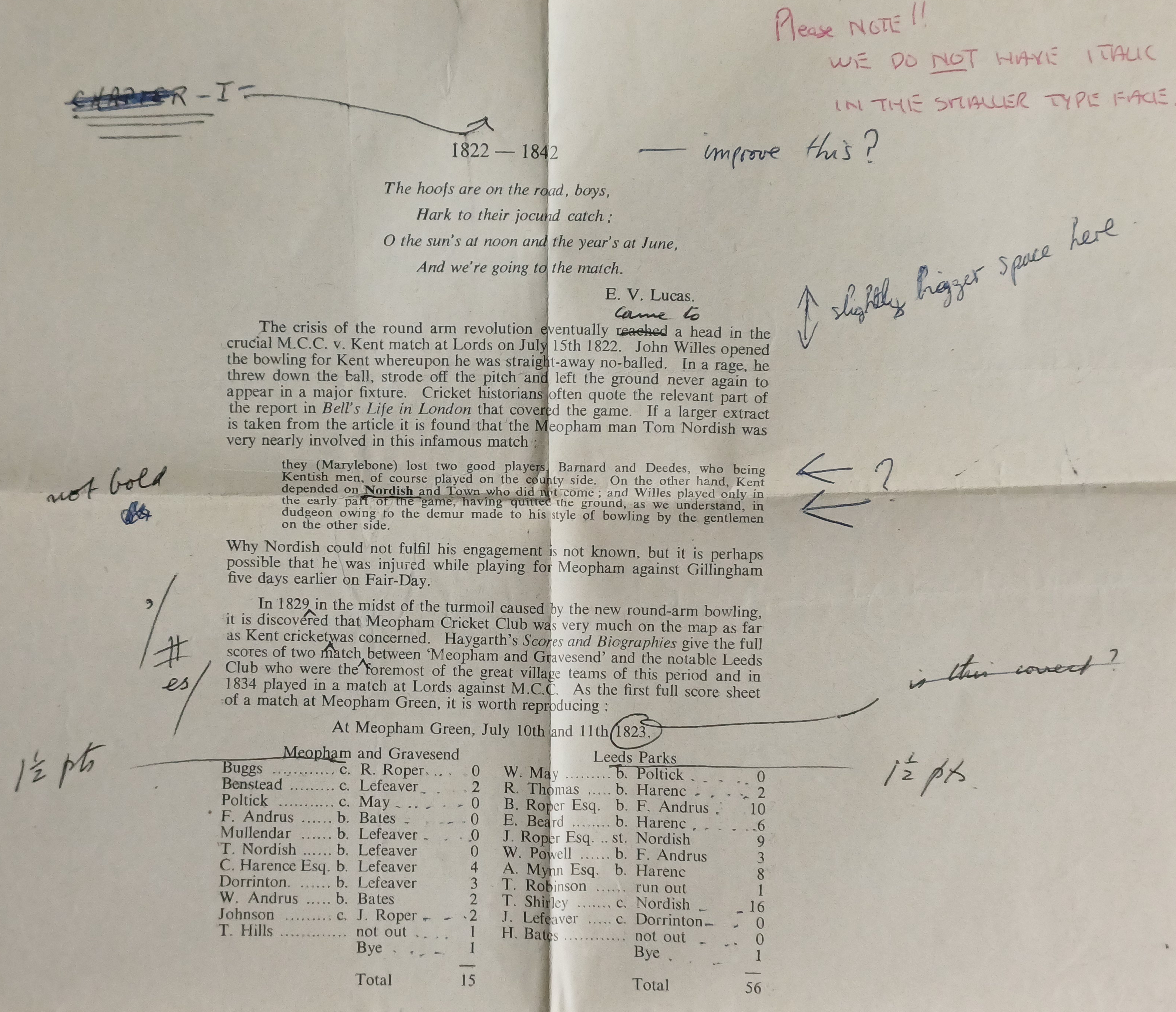
Awareness of the stark contrast in working methods between the two projects has been a constant presence over recent months. In 1976 I could do little at home beyond the writing; no online databases, no online catalogues of archive centres, no Wikipedia, no Google, no email. It is not difficult to explain the 21st-century improvement in the standard of cricket books.
Once inside a reference library (as they were called), the only technical aid on offer was a microfilm reader, a tool of maddening inadequacy. My myopia doubtless worsened in those hours of winding through Bell’s Life in London and Sporting Chronicle in the Westminster Library. In Colindale, located at the periphery of the London Underground, 18th-century newspaper files had become almost too fragile to handle.
It didn’t help that I was the archetypal callow youth, struggling to persuade gatekeepers of information that I was serious in my purpose. Arriving on a motor-cycle and displaying 1970s density of hair created doubtful first impressions. The exceptions stood out; Stephen Green, then the archivist at Lord’s, and John Goulstone, the recognised leading researcher of early cricket.
The only available copying technology at home was carbon paper. Printing costs were high and I had to persuade the Club Chair to underwrite the project – which he did only after rejecting initial quotes.
I also had a full-time job and, in the summer months, played cricket for Meopham every Saturday and Sunday. Whatever the shortcomings of the end result, I marvel at the achievement of my younger self. We sold 1,000 copies through that wonderful summer without difficulty and covered the costs.
Today is so different. As John Goulstone himself has recently observed: “a multitude of hitherto unknown references are now easily accessed on a home computer by the simple process of clicking onto the word cricket in the appropriate box.” The cost of printing the Romney booklet was less than double the 1976 figure, with the added benefit of improved binding. By contrast, the £10 sale price is twenty times the “ten bob” asked for the 1976 booklet.
It’s not all plain sailing with digital tools. For most of the period of my research, the British Library was unable to sustain many of its relevant services. The appalling cyber attack that it suffered is a reminder that the risks inherent in the online world carry very high impact.
The invaluable British Newspaper Archive has more insidious failings. Within the last two or three years the brief but vital notice of the death of Valentine Romney in the Kentish Gazette of December 25, 1773 has vanished from the search results. It seems that the technology is struggling with faded or blurred originals. Meanwhile, the Gale database of the 17th and 18th Century Burney Newspapers Collection has trouble recognising the word cricket when printed in old-fashioned capital letters.
These are relatively minor quibbles. These databases and those accessing parish registers and census returns, such as FindMyPast, are gold-dust for researchers. This is highlighted by the cliff edge that drops to the mass of archive material that remains beyond the reach of available budgets for digitisation. The oldest churchwardens’ accounts for Meopham have been designated as unfit to handle, closed to researchers and languishing in an queue for funds.
Aside from the technology, the passage of years has awarded me many advantages in researching the life of Val Romney. I have the leisure time of retirement; I can afford to subscribe to online database tools and to buy books. I was able to purchase a complete run of The Cricket Quarterly, a short-lived but vital source of accurate research dating from the 1960s.
My elderly appearance is now a good match for the expectations of professional archivists and others whose help makes a difference. And I sold my last motor-cycle in 1980.
I can’t help noticing the excellence of the Trove digital archive maintained by the National Library of Australia. It boasts: “everything you would find on a visit to a library or museum can be found in Trove.” I don’t know how true this is but it would be an attractive goal for UK local archives.
Part of me hesitates over this utopian concept. There is an especial thrill in making a rare discovery after hours of perusal of original documents. A computer screen deadens the experience.
I recall the December day in 1975 in the old Maidstone Archive office spent unfurling 18th-century scrolls of recognizances for licensed victuallers. I discovered that the pub on Meopham Green had been renamed “The Eleven Cricketers” in 1735, making it the oldest known cricket pub in Kent.
In that instant I had shifted the evidence of cricket in Meopham back by two generations. Fifty years later I found an important newspaper reference that has somehow eluded cricket historians. I used a digital search tool to do the work. It was a good moment but missing the elation of the former experience.
The same is true of the writing process. The 1976 booklet was written in longhand (at least three times). My room was crammed with a full set of Meopham parish magazines, all the church registers, parish overseers’ and churchwardens’ accounts, framed photographs from the cricket club, and countless letters, then the medium of communication. I had somehow assembled everything for frantic last minute reference.
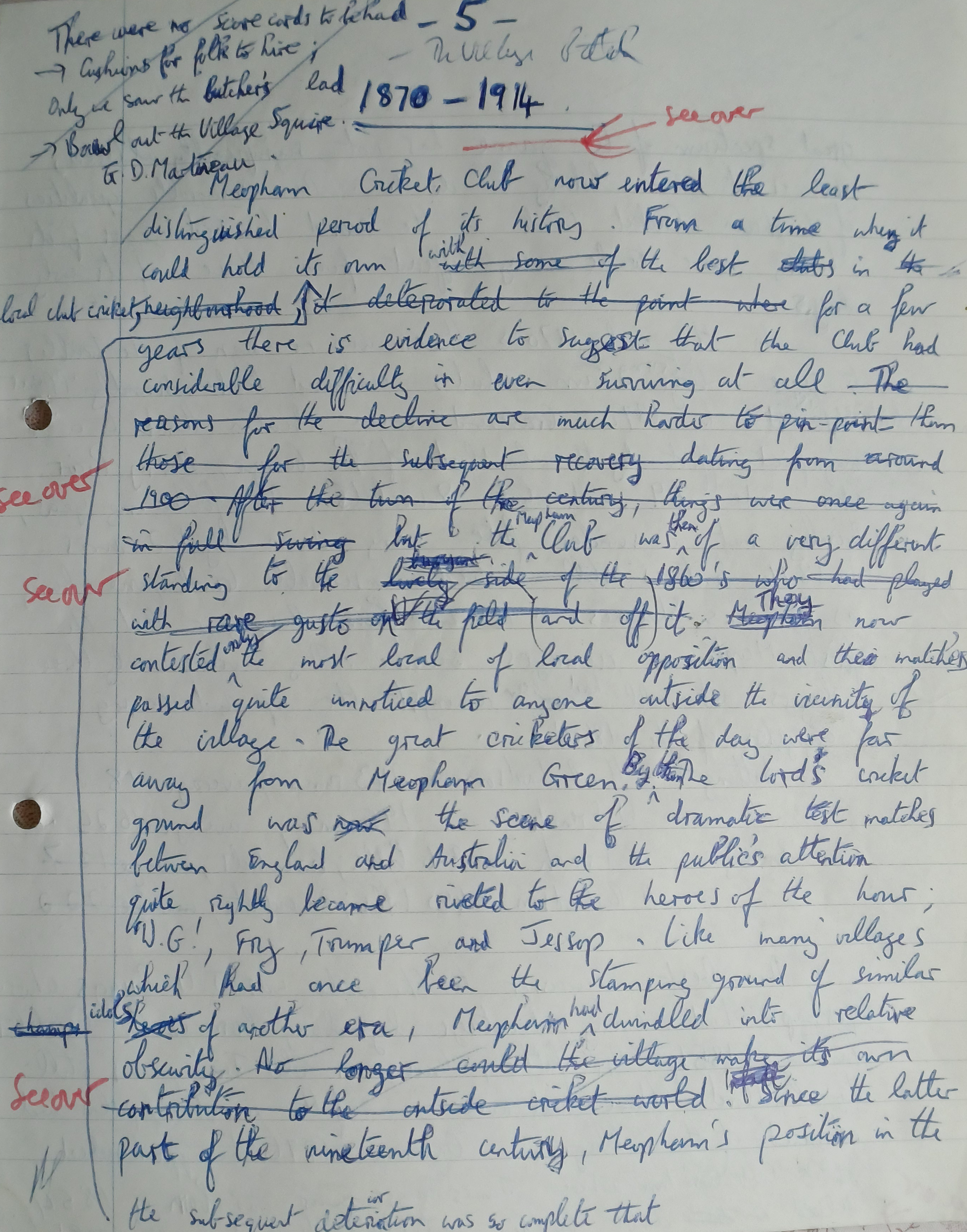
Nothing I have done since with a word processor has recreated the seamless connection between subject and written word that I felt in those weeks at Meopham. We are told that AI can write books; in our genre these can only be the worst sort of history that rewrites what others have researched. The analog trove of old manuscripts lies beyond the bots. We should enjoy the old ways while we can.
******
The Life of Valentine Romney by William Gunyon, self-published 1st May, 2026; 62pp pbk, fully illustrated. A limited edition of 250 numbered copies.
Available at £10 from J.W.McKenzie Specialist Cricket Bookseller, as sole distributor.
*I also produced The Cricketers’ Inn at Meopham in 1985. This was a fundraising project, intended to be humorous.